logo
Recent letters
Archives of letters to the editor

{short description of image}
Calling progressive screeds 'prophetic' shows abysmal judgment
May 12, 2008
"Progressive theology" typically justifies what otherwise would constitute hatred, racism, classism, sexism and general entitlement of celebrity victims as "being prophetic." I notice that these self-proclaimed "prophets" maintain a progressive lifestyle: not a hair-shirt among them and most look like they've been eating more than a diet of locusts and wild honey.

Both Mr. Wright and those who defend him defame the prophetic tradition as well as preachers throughout the ages who lifestyle of suffering and dedicated service wasn't backed up by ostentation and self-righteousness. Calling these screeds and rants "prophetic" shows abysmal judgment.
Donald D. Denton
Richmond, Va.


GA must recognize PCUSA's loss of members
May 12, 2008
Being in Africa, I've just received the special two-volume edition of The Layman, which features the Katrina relief effort. Inside, it repeats the doleful statistics of how the PCUSA, with its predecessor denominations PCUS and UPCUSA, has lost half its membership since the mid-1960s. The number of missionaries has dropped from 1,900 in 1959 to less than 200 today, although support to the militantly leftist World Council of Churches is maintained.

It seems clear to me that the leadership of the PCUSA have over the years been in denial. When I say denial, I'm not talking about a river in Egypt. If the PCUSA were listed on the New York Stock Exchange, what would its stock be worth today?

Although I'm in the EPC, I honestly would hate to see the PCUSA go down the tubes; it means so much to so many godly people. And I've learned that denominational labels don't really mean diddly-squat anyway. There are sub-groups in every denomination, and that sub-group in that denomination over here, and that sub-group in that one over there, can more easily communicate with one another than either can communicate with the mainstream of their respective denominations. There are PCUSA churches in which I would still feel comfortable.

In about six weeks the PCUSA will have its General Assembly. I hope that as it observes 25 years of being a reunited denomination, there will a frank recognition that it has lost almost a third of its people since 1983. I hope that someone gets up there and has a real epiphany: "Hey! We're dying!"

That would be the very first step in revitalizing a once-great denomination.
Larry Brown
African Bible College
Lilongwe, Malawi


Information on female deacons
May 12, 2008
The Presbyterian Church of America will be dealing with the question of setting up a study committee for possible changes to its Book of Church Order with regard to female deacons. Here is a Web site compiling all the information. We are always looking for more links, if anyone has any to suggest.
Marshall St. John Jr.


'It rather appears the Reformation is gathering a second wind!'
May 12, 2008
Within the preponderance of measures implemented in Louisville and the various synods in the PCUSA to prevent churches from leaving, one may easily determine why so many are thus inclined. These strong arm methods are symptomatic of the reliance on man-made protocol and conveniently manufactured precedent in lieu of explicit Scriptural justification. This is the very penchant, one clearly rooted in the culture of rancid cliquishness, secularism and power-mongering, that led a certain German monk to post a document on a church door in Wittenberg, Germany.

It rather appears the Reformation is gathering a second wind!

If given unflinching consideration, this tendency of our so-called leadership is at the very heart of all that ails us as a denomination. We know not what the future holds, yet we certainly should draw a little perspective from the past.

Pearl S. Buck, daughter of a Southern Presbyterian missionary, once wrote that "knowledge of history as detailed as possible is essential if we want to comprehend the past and be prepared for the future." The tradition rich Reformed diaspora, with all concomitant scholasticism inherent, offers us a wealth of insights to this end.

Centuries ago, issues of this sort and their consequences were addressed by Calvin, himself:
Since men have turned aside from pure and holy obedience to God, they have discovered that good intention was sufficient to approve everything. This was to open a door to all superstitions. It has been the origin of the worship of images, the purchase of masses, the filling of churches with pomp and parade, the running about on pilgrimages, the making of vows by each at his own hand. But the abyss here is so profound that it is good enough for us to have touched some examples. So far is it from being permitted to honour God by human inventions, that there would be no firmness nor certainty, neither bottom nor shore in religion: every thing would go to wreck, and Christianity differ in nothing from the idolatries of the heathen. (Cited from Calvin's Tracts and Treatises, vol. 2.)
I've long determined those currently at the bureaucratic helm of the PCUSA are but expendable agents who are selected by cabals well beyond the camera lens; intent being to debase classical apologetics to further globalistic interests. They will sooner or later be forced to recognize the link between constitutional semantic manipulation and widespread disinterest, reflected by paltry returns in the collection plate. In likely course, individual congregations, aghast by the venom and wanton disregard for Scriptural authority, will feel less bound to adhere to the precedent of requesting dismissal from the PCUSA. They'll simply leave, period! Hence, the threat of Synodical coup d'etat will be greatly diminished.

Will the last person out of the PCUSA please turn out the lights? After all, we don't need an electric bill as staggering as general impiety of the upper echelon.
Eric Wells
Boardman, Ohio


Fair and balanced
May 7, 2008
Thank you Layman for printing Jerry Voight's letter (May 5).

Having lived in South Carolina for five years, I didn't think there were people with Jerry's views living in that state. It is refreshing to see that The Layman continues to be fair and balanced in its reporting.

It is for that very same reason that I watch Fox News exclusively.
Ed McLean
Maitland, Fla.


Logic spiral
May 7, 2008
The recent GAPJC decision on Jane Spahr's defiance of the Scriptures and the PCUSA constitution signals how thick the absurd self-deception of some in the PCUSA has grown. Such illogic does not pass the fifth grade reasoning test.

The fact that the majority of the PJC can produce such a decision with a straight face is a sad and disturbing sign of the insulated world of theological/bureaucratic haziness that surrounds this denomination. They actually think this makes sense.

Well, it does, but only if you have spiraled downward in a Romans 1 kind of way.
Rev. D. Wayne Bogue
Hudson Presbyterian Church (NWEPC)
Hudson, Ohio


Assumption of Justice, Pt. III
May 7, 2008
Lloyd Lunceford is right in stating in his May 5th letter that there is no legal support for a denominational claim of a trust interest in local church property. He also debunks any claim of historical support for a denominational trust. My letter of May 2nd clearly shows that there is no Scriptural support for a denominational trust. Why, then, is there a trust claim in the Book of Order? Why does the Book of Order make this questionable claim when by its own admission, it is "purely moral or spiritual in its object, and not attended with any civil effects"? G-1.0308

Mr. Lunceford wonders what the denomination's in house lawyers were thinking when they give advice contrary to the clear reading of the cases and the law. I would suggest the Louisville Papers give clear evidence of what they were thinking. The denominational lawyers are attempting to use un-Godly and un-Biblical methods to confiscate local property that the denomination did not buy or pay for. The denominational lowerarchy has never repudiated the Louisville Papers or their secretive practices.

Local ownership of church property by particular churches is one of the principles that the founders of Presbyterianism, Calvin and Knox, instituted as a means of protecting doctrinal purity. The accumulation of property, money, and power in a hierarchical regime resulted in an apostasy from Biblical beliefs and practices. This apostasy led to the Reformation. Limiting the hierarchy limits the idolatry of property, money and power which leads the visible church astray. The denominational trust claims, lacking any legitimate basis, have led only to strife and controversy. Where, I ask, is the PCUSA going?
Donald G. Nichol
Walden, N.Y.


See you in heaven
May 7, 2008
(Re the homegoing of Dr. R. Laird Harris)

He was my Hebrew and ancient Acadian and Old Testament Biblical studies Professor at Covenant Seminary in the early 60's. Because of him, I still prepare Old Testament sermons from the Hebrew text and enjoy word studies.

A gentle soul but a bear of a scholar. He was a quiet giant of the faith and I love him even after 40 years. See you in heaven, Dr. H.
Rev. Bill Solomon
Montreat, N.C.


Wright was wrong response
May 7, 2008
(re: The Rev. Wright Was Wrong)

Amen, and two wrongs won't make it right!
Fred Hoaglin, elder
Providence Presbyterian Church
Hilton Head Island, S.C.


Presbyterian or Episcopal?
May 7, 2008
So once again the PCUSA is looking less and less Presbyterian in government and more and more Episcopal.

The PCUSA – with its top down power plays – gives a lot of lip service to this "connectional" form of government but in reality they are not.

While I agree with the top down model, I am just glad I made it into a communion that is validly Episcopal rather than just acting that way.
Dennis Russell
Kalamazoo, Mich.


Unhappy reader
May 5, 2008
I cannot believe the ignorance, bigotry, self-serving prophetizing (sic) and hate-filled divisive talk that is certainly not journalism or truth. This "paper" is an insult to the Presbyterian church with its backward thinking and low intellect (sic) tone of your pursuit of self-elevating power.

It must be about the money. I wish you would claim your faith and just leave – go join the EPC if your faith is so sure! You are starting to act like the radical Islamic terrorists with your "talk." But like them, it too is about the power of oil and money.
Jerry Voight
Hilton Head Island, S.C.


Amendment: Assumption of Jurisdiction
May 5, 2008
Don Nichol, an astute attorney and faithful elder, makes some very good points in his May 2nd letter, but I humbly offer a postscript.

His letter concludes by admonishing the PCUSA for basing its Book of Order claim of an enforceable property trust on a U.S. Supreme Court decision rather than basing its claim on Scripture.

The PCUSA's position is actually even less defensible than my colleague Mr. Nichol suggests. The PCUSA's claim finds no support in the U.S. Supreme Court either.

The case often relied on by PCUSA officials, Jones v. Wolf, 443 U.S.595 (1979), actually made clear that any trust claims in denominational constitutions must be the product of mutual consent. The Supreme Court in Jones said,"[T]he parties can ensure, if they so desire, that the faction loyal to the hierarchical church will retain the church property. They can modify the deeds or the corporate charter to include a right of reversion or trust in favor of the general church. Alternatively, the constitution of the general church can be made to recite a trust in favor of the denominational church…[C]ivil courts will be bound to give effect to the result indicated by the parties, provided it is embodied in some legally cognizable form." Id. at 606 (emphasis added).

The need for clear consent by the local property owner of record – the other party – is unavoidable. Jones did not allow national denominations to expropriate locally owned property by unilateral fiat. Jones merely recommended mutual, pre-dispute agreements in some form ordinarily recognized by the civil law as enforceable. That usually requires clear and express consent in writing by the local property owner, among other requirements. But congregational votes were not part of the amendment process when the trust clauses were added to the Book of Order. Moreover, in many ( probably most) cases, the actual property owner of record – the other party – is the local church corporation, whose members and board of directors were not consulted and had no official say in the amendment process. And subsequent, long association with the denomination did not convert a property right previously vested in the local corporation into a non-vested right up for grabs by the denomination.

In response, PCUSA officials have argued that the local church corporations are subject to the PCUSA's Book of Order – as the Book of Order not surprisingly claims for itself. However, under the law of every state in the Union, a local religious corporation, formed by the state, is a separate legal entity than its corresponding local congregation. The local corporation has separate functions and powers, like holding title to local church property. Accordingly, courts that follow neutral principles of law have typically rejected attempts by national denominations to use self-dealing ecclesiastical edicts to subordinate and control civil corporations.

Jones held that applying to religious institutions the same property law everyone else had to obey ("neutral principles of law") did not violate the federal constitution's religion clauses. Another, older, U.S. Supreme Court decision is also worth noting on this topic of a claimed enforceable trust in favor of the national denomination. Watson v. Jones, 80 U.S.679 (1871) had previously given states the option of deferring to ecclesiastical authorities (in hierarchical denominations), as a method to resolve local church property disputes. In a much publicized column appearing a year or so ago in The Presbyterian Outlook, PCUSA lawyer Mark Tammen and former PCUSA lawyer Eric Graninger curiously cited Watson in support of their controversial assertion that a property trust over local church property had been a feature of Presbyterianism since its 16th Century inception, and was "essential" to Presbyterian connectionalism. Left unmentioned in their article, though, was Watson's specific explanation of the real party in whose favor this ancient trust was to benefit. By this omission readers were left to conclude that this ancient trust concept was for the benefit of the national denomination, i.e., the same beneficiary now mentioned in the Book of Order.

Nothing could be further from the truth. Tammen and Graninger left readers to incorrectly mix apples and oranges. The Book of Order asserts an alleged trust for the use and benefit of the PCUSA, the national denomination. In stark contrast to this, the U.S. Supreme Court in Watson instead expressly rejected the proposition that a trust always existed in Presbyterianism in favor of the national denomination. Citing Watson for this proposition stands Watson on its head. One doesn't need a law degree to see this, only an ability to read English.One can only wonder what Tammen and Graninger were thinking.

In Watson the court was confronted with two competing trust assertions. One party contended that in Presbyterianism a trust always existed favor of the majority in a local congregation. The other party contended that in Presbyterianism a trust always existed in favor of the national denomination (called "the general body" in Watson). The U.S. Supreme Court rejected both contentions. In doing so, it said that prior to 1813 the courts had not settled on any definite rule. In 1813, though, the House of Lords ruled in a case arising in Scotland (which Watson characterized as the "native home of Presbyterian faith and form of government") and rejected both contentions, in the case of Craigdallie.v.Aikman, 2 Bligh, 529 ;1Dow. Since that time, the U.S. Supreme Court went on to say, Craigdallie's ruling "has been accepted in all cases of this nature in England, Scotland and America." Watson at 705.

Instead of a trust existing always in favor of either the majority of the local congregation or in favor of the national denomination, Watson said that any potential trust existed only in favor of that part of the society (whether local or national) …" adhering to and maintaining the original principles upon which it was founded." Id. Because the civil courts of the state should not be making such intrinsically religious decisions about doctrinal fidelity, Watson authorized state courts to defer to ecclesiastical bodies ( in hierarchical denominations) to make this determination.This approach is called the hierarchical deference rule. While still constitutionally permissible, most states have since opted for the more favored neutral principles of law approach.

But by whatever method is followed to resolve local church property disputes, whether hierarchical deference or neutral principles, the U.S. Supreme Court long ago rejected the notion that an enforceable property trust, always for the benefit of the national denomination, is inherent in what it means to be Presbyterian or somehow essential to Presbyterian connectionalism.

Any contention to the contrary is a modern myth, asserted unknowingly or for momentary convenience by those who would try to convince others that confiscating property that has been bought and paid for by others and titled in another's name is somehow godly or biblical.
Lloyd J. Lunceford, Esq.
Baton Rouge, Louisiana
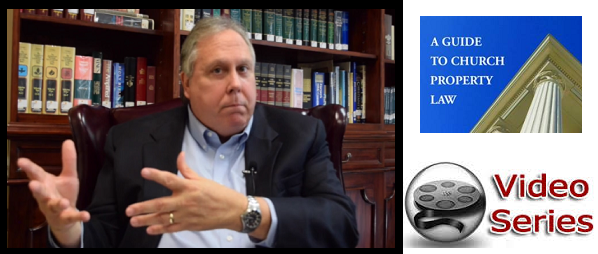
(Ed. Note – the author is the general editor to A Guide to Church Property Law (Reformation Press) and an attorney with Taylor, Porter, Brooks & Phillips, LLP, Baton Rouge, Louisiana)


Defining marriage
May 5, 2008
It is easy to think of a variety of alternate arrangements to marriage between a man and woman. Suppose a Presbyterian minister conducted a ceremony between a man and a child. Is this still a marriage? Any if not – can anyone be sanctioned or disciplined?

A better question is: What standards does the PCUSA still maintain or believe? The Presbyterian church is in a free fall down a slippery slope with no landing in sight.
Rob Morris
Princeton, New Jersey


If my people
May 5, 2008
The recent issue (Spring 2008) of The Layman revealed a fact that should be dealt with by the PCUSA (not just "addressed"): The Lord cannot bless the PCUSA for allowing "sin in the camp" – specifically homosexual behaviors, marrying of gays and lesbians, and other blatant allowances. Certainly, sinners saved by grace should reflect the change that has taken place, as stated in our Bibles.

When Presbyterian churches wish to withdraw from the PCUSA, their church buildings and property are absconded which have been built and supported over the years to meet the spiritual and communal needs of that congregation, for God's glory – when church property is taken, how do you think that a sale (if possible) will be a blessing to those in that community where it has been a "lighthouse" for many years and used to reach the lost and nurture Christians in their faith?

2 Chronicles 7:14 is still applicable today: "If my people, which are called by my name, shall humble themselves, and pray, and turn from their wicked ways; then will I hear from heaven, and will forgive their sins, and will heal their land..."
D.B. Johnson
Mora, Minn.


What happened?
May 5, 2008
What has happened to the church I grew up in?

This is the church I learned all of these things in – chastity, charity, honesty, and that the Word is a precious compass for our lives. Growing up, I was proud to let people know: "I am Presbyterian." I equated even the word presbyterian with "unwavering" in my mind. Upon visiting the GA as a teenager, I felt unworthy to even step on to the carpet in the room.

I have watched the church of my youth dissolving before my eyes; a church that has now become so steeped in "Christian activities," but hisses like an angry cat if someone dares to quote a Scripture verse, or invites an impoverished passerby in to the Sunday service. The thought of leaving the church where my family has been for over 50 years, where I was married, and where my 3 boys have been baptized (by ministers who were like family to us) has left me saddened beyond words.

May Almighty God bless your efforts and multiply them and I pray you will not become discouraged.
Karen Brock
Joplin, Mo.


Swimming against scholarship
May 5, 2008
Regarding Professor who shuns Reformed theology hired to teach it at Davidson College:

I'm reading Timothy Keller's The Reason for God. This, along with N. T. Wright's The Resurrection of the Son of God, and other studies causes me to think the 'progressives' are swimming against the tide of recent scholarship.
William G. Billings
Bartlesville, Okla


Assumption of Jurisdiction – Synod of the Sun
May 2, 2008
The Synod of the Sun has purported to appoint an administrative commission ("AC") to have final approval of property decisions in the Presbytery of South Louisiana (see The Empire Strikes Back).

This action clearly signals that the Presbyterian Church (USA) is attempting to become what it has instructed its lawyers to represent that it is – a hierarchical (not Presbyterian) church.

I fail to find any support in the PCUSA constitution for what the synod has purported to do in claiming original jurisdiction for its AC in property decisions. The property decisions are clearly within the realm of the lower judicatories. The claim that "All pending and future decisions regarding property in the Presbytery of South Louisiana shall require the approval of the commission" is clearly seeking to usurp authority which does not belong to the synod.

The letter to synod, from the few kvetching about the presbytery's actions recognizing local church ownership, clearly requests the formation of an AC to take "original jurisdiction." Search the Book of Order to find any authority for synod appointing an AC to take "original jurisdiction" over any presbytery (or particular church) function. I find none.

"Original jurisdiction" is a term of art used for the court which has the authority to initially decide a "case." The Rules of Discipline define what a "case" is. As I wrote in a previously published article in The Layman, the use of the G11.0103(s) authority to takeover the offices of elders on session under the guise of assuming original jurisdiction is a misuse of such authority. Original jurisdiction is limited to a particular "case." It is not a right to occupy the offices of elders on the session, whose election to those offices is an inalienable right of the congregation. G-6.0107 Such a usurpation is hierarchical in nature and not Presbyterian. Here, the synod's action does not have even the pretense of authority claimed for a presbytery AC by virtue of G11.0103(s). It is totally contrary to the Presbyterian system.

Look at the basis for the establishment of Presbyterian governance. It is stated in the Westminster Confession, Book of Confessions, 6.173:

"For the better government and further edification of the Church, there ought to be such assemblies as are commonly called synods or councils [all higher judicatories]: and it belongeth to the overseers and other rulers of the particular churches, by virtue of their office, and the power which Christ hath given them for edification, and not for destruction, to appoint such assemblies; and to convene together in them, as often as they shall judge it expedient for the good of the Church."

The power and authority in Presbyterian governance is given by Christ, found in particular churches, and delegated "upward" to higher councils convened by the local elders as deemed expedient. The authority does not come down from any self proclaimed hierarchy. Indeed, we are warned of the "greater danger from the usurped claim of making laws."

Historically, Presbyterianism was held together by shared belief in the sovereign LORD and the rule of His revealed Word. Now, when He and His Word are no longer highly regarded, but twisted into shadowy likenesses of what suits the whims of those who preach another gospel – which is no gospel – then, the powers that be must invoke obedience to hierarchy, rather than obedience to His Word, in an attempt to hold things together. These usurpations and misuses of authority must be denied, and shown for what they are (Book of Confessions, 3.20) or we shall have what they desire – a new monstrosity which ought properly be called the Hierarchical Church (USA).

What I find most disturbing regarding the ongoing property squabble is the lack Biblical, theological support for the positions of the parties. I was taught that the one question a Presbyterian asks when presented with any issue is "What does the Bible say?" Can the PCUSA adopt any position which is not simply declarative of the revealed Word?

I find plenty of Biblical support for local ownership of particular churches (Rom 16:5, 1Cor 16:9, Phil 4:15, Phm 1:2, & 2John 10). I find no Biblical or Confessional support for a denominational trust. The Westminster Confession, Book of Confessions, 6.148, tells us that property rights are not affected by church relation. The Confession cites Acts 5:4 as its authority.

The founders of Presbyterianism, Knox and Melville, in the Books of Discipline of 1560 and 1578 placed church property in the control of deacons, a local church office. Why then does anyone think that the fact that virtually every lot, plot, and parcel of real property, and the improvements thereon, is titled in the name of the local church is not a reflection of the intent of the parties concerning ownership of that property? Was there no one who could draft a trust clause for the deed if that were the intent? Nonsense!

The trust claims lately tacked onto the Book of Order were based on a mistaken belief that the US Supreme Court in 1979 invited denominations to make a unilateral declaration of a trust interest in local church property. However, effective trusts may be declared only by the existing title owners, not the beneficiaries. The trust claims represent a violation of the 10th commandment in their claiming of property which does not – and never did – belong to the denomination.

Those that contend for a denominational trust should be ashamed that the source of their belief comes from a Supreme Court decision and not from the Word of our God.
Donald G. Nichol
Walden, N.Y.
(Ed. Note – Mr. Nichol is an attorney with Jacobwitz and Gubits, LLP, and a Presbyterian elder)


Closer fellowship
May 2, 2008
I just wanted you to know how very much I enjoyed the editorial by Parker Williamson and the column by Chuck Burge (Spring 2008 issue of The Layman – ed.). I am an elder at First Presbyterian in Mooresville, N.C. I just turned 80 last month. I remember very well seeing this whole business coming in the days of the PCUS. I remember vehement denials that there was any plan "a foot" to merge with PSUSA! Ha!

Both of your well written columns reminded me of a quote from A. W. Tozer: "One hundred worshipers meeting together, each one looking away to Christ, are in heart nearer to each other than they could possibly be were they to become 'unity' conscious and turn their eyes away from God to strive for closer fellowship." Thanks for all you're doing.
William Smith Kirk
Mooresville, N.C.


Spahr decision indicative
May 2, 2008
So, Rev. Spahr has been exonerated of the offense she was accused of committing, because the offense she was accused of committing doesn't exist?

Brilliant! Lewis Carroll should have included that one in Alice in Wonderland.

I'm afraid that all this is indicative of how next month's General Assembly will go. The only thing that seems holy to the PCUSA power structure is perpetuation of the status quo.

So just watch: the people elected to the offices of moderator and stated clerk will be clones of their predecessors. The left wing will almost, but not quite, succeed in getting unrestricted ordination of homosexuals passed.

And so on and on it goes.
Larry Brown
African Bible College, Malawi


Love crime?
May 2, 2008
Concerning the story link: "Moorpark Presbyterian Church vandalism suspected hate crime" to the Ventura County Star:

Did anyone think it was a love crime?
Pete Simpson
Bloomington, Minn.


Clear intent
May 1, 2008
I'll have to differ with Mr. Millbrook (letter to the editor, posted April 30, 2008).

Jane Spahr's interpretation of 'is' was never in doubt. She was perfectly clear in stating that she was performing marriages. She was quite bold in doing so and it seems obvious to me that she wanted to be reprimanded. Her tactic was to force the issue using the church courts as a platform for her views.

Whether you agree with her or not, Jane was always clear as to her reasons for doing what she was doing. It is the GAPJC that is trying to redefine terms here, not Jane Spahr.

This decision will do nothing to aid those who advocate for GLBT issues in our denomination. In fact, it appears to me to be a slap in the face to all of those who have ever participated in such ceremonies. It is nothing less than denominational censorship of those who are crystal clear in their actions and beliefs.

Absolutely ludicrous.
Rev. Nathan Lamb
Hartford, Iowa


Slanting Spahr story
May 1, 2008
Putting the desired slant on the news, Louisville's house organ, the PNS (Presbyterian News Service), headlined its report of the Spahr decision with the words "Spahr found innocent...."

Wrong! Spahr has never denied that she did the things she was charged with. The GAPJC simply used a judicial ploy to declare that those things were a judicial impossibility and not punishable. It is one thing to say "I didn't do it. I am innocent." and quite another to say "I did it, and you can't do anything about it."
Michael R. "Mac" McCarty


Left behind?
May 1, 2008
The Presbyterian Church (USA) gets weirder and weirder.

Jane Spahr said she performed these weddings and should be reprimanded for breaking the rules of the church. This church, in my opinion, is doing more to serve Satan than Jesus.

Are you trying to ruin the whole church?

I attend a small church in Ardara, Pennsylvania: Redstone Presbytery. Our pastor has already taken retirement rather than try to preach under conditions that are not Scriptural.

Jesus is coming soon to take His church home. I am not sure if you all won't be left behind.
Lloyd Myers
Trafford, Pa.


Physics of Resurrection
May 1, 2008
(Regarding the commentary on Douglas Ottati, theology professor for Davidson College – Ed.)

The article states that Dr. Ottati doubts the bodily resurrection of Jesus because of the "physics."

By this I presume he means there is no principle of physics that would permit a resurrection. He may be right – there is no such principle that we know of now. Our understanding of existence is limited to our five senses as interpreted by the gray matter in our skull.

Are we to say that unless we can see, taste, hear, touch or smell it, it cannot exist? Did infrared exist 100 years ago, even though we could not see it?

It is likely that there are many aspects of existence which we have as yet been unable to measure, or perhaps will never be able to grasp because of the limitations of our physical natures. This does not mean they are not real, including the resurrection of the body. To deny this possibility is unscientific.
Chris Small
Winston-Salem, N.C.


Malawi miracle
May 1, 2008
One Sunday night, about four weeks ago, I was at the home of African Bible College founder and president Jack Chinchen. We have a Sunday evening vespers service at the ABC chapel, and then the Chinchens have staff members over for waffles and pancakes. But on this particular occasion Toni Moffatt, the administrator of the Community Clinic, came bursting into the house, in a hysterical state. "I hit somebody! I hit somebody!"

Just after dark, she was on the Mchinji Road on her way to our campus and was perhaps half a kilometer from our entrance when a man ran out in front of her. There was no way that she could have stopped. She pulled off on the side of the road and got out of her car and attempted to flag down passing cars. Nobody stopped, and two men on foot suddenly appeared and said, "Get out of here! Get out of here! Go! Go!" Flustered, she jumped into her car and came to us. Later it was found that her car was so badly damaged that it had to be put into the shop.

Hitting a Malawian pedestrian with your car is an expatriate's worst nightmare. Last year I got stopped for doing 80 kilometers (50 mph) per hour in a 50 (30 mph) zone (open highway, no other vehicles in sight). The police took my license, threatened to impound my vehicle, and the next day I had to pay a 40,000 kwacha ($300) fine. I know another white expatriate who was given a one-year suspended jail sentence because the mandatory insurance decal on the windshield expired the day before. And people here can be oblivious; they aren't taught from childhood to look both ways before crossing the street. Once I was driving down a street and a man walked into my moving car while talking to some friends standing on the curb behind him.

So anyway a bunch of men including our physician, Dr. Mark Boersma, jumped into my car and we drove to the scene of the accident. They looked at the body of the man – lying on the side of the highway – by the light of my car headlights. His shoes were on the highway. He was still breathing, but his head was split open and was bleeding profusely, and his brains had spilled out. Also, he had a broken leg. Mark said that it was impossible for him to survive the night.

The police arrived on the scene. Normally, if you want a policeman, you must be able to drive to the station and pick one up; they're short on vehicles. But we called by cell phone McLeod Munthali, our radio station manager, and he went to the station and got a pair of cops and brought them out to us. At first, the cops insisted that I take the bloody body to Lilongwe Central Hospital in my car. This is a place where patients have been known to starve to death because there was no one to feed them. But then, a police truck arrived, and the cops stuffed the man's brains back into the cranium and heaved the body like a sack of potatoes into the truck and drove off.

A few days later, I learned to my surprise that the victim had survived the night. A few days after that, I was further surprised to hear that he was conscious and was beginning to speak.

Last night I learned that the victim has been dismissed from the hospital and is now at home. He is able to give an account of that evening. Two men (maybe the ones that told Toni to go?) were trying to steal his bicycle, and then started chasing him. In fear for his life, he ran out into the highway. He says that he thought people would stop for him. Had Toni not hit him, perhaps the robbers would have caught up with him and killed him.

Up till now, I've said that miracles are like UFOs and Bigfoot; they get reported by other people, but you never see one yourself. But now I have a first-hand miracle story to tell.
Larry Brown
African Bible College, Malawi


Home · News · PLC Publications · The Layman
Online Reviews · Archives· History of the Lay Committee · Feedback · Links